How the Eri Spinning Mill Could Support Rural Economies in Assam
- HR NEHHDC
- Jun 12, 2025
- 2 min read


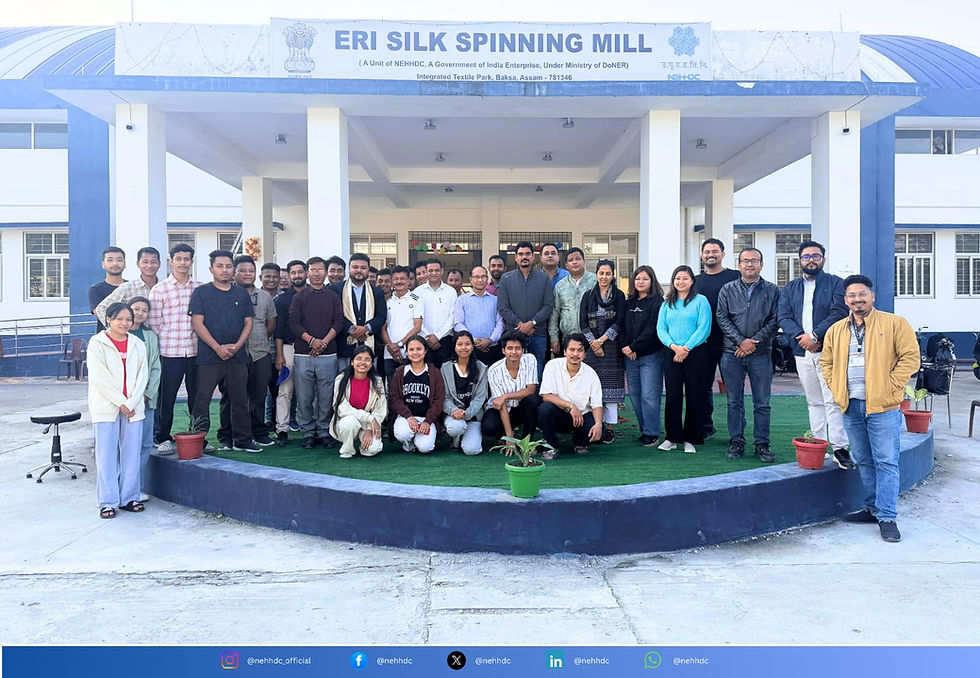
Nestled in the heart of Assam, the Eri Silk Spinning Mill established by NEHHDC is more than a production unit—it is a force of economic renewal for hundreds of rural families. While the world recognizes Eri silk for its softness, thermal comfort, and ethical production, few know the human ecosystem behind its making.
This article explores how the mill is actively supporting cocoon farmers, tribal women, village-level entrepreneurs, and traditional spinners, creating a sustainable chain of livelihoods rooted in the villages of Northeast India.
1. Cocoon Sourcing: A Lifeline for Rural Rearers
The Eri Silk Spinning Mill sources cut-open cocoons from nearby villages, ensuring that silkworms are not harmed—a cornerstone of Ahimsa (non-violence) silk. Cocoon rearers, many of whom are small farmers and women-led families, receive direct payments at fair prices.
✅ What this means:
Regular income for cocoon producers
No middlemen exploitation
Rural self-reliance through indigenous practices
2. Employment for Rural Women
The mill prioritizes hiring local women for spinning, reeling, and basic operations. For many, this is their first formal employment—offering not just wages, but identity and empowerment.
🧵 Women are trained in:
Manual and semi-automated spinning
Sorting and cleaning of fibers
Quality checks and packaging
3. Artisan Integration: Strengthening the Craft Chain
Handloom weavers across Assam depend on quality yarn. By offering standardized Eri silk yarn in counts like 30 Nm, 40/2 Nm, and 80/2 Nm, the mill ensures that weavers receive consistent raw material for their looms.
The result?
🔹 More efficient weaving
🔹 Higher market value of finished products
🔹 Easier access to institutional orders through NEHHDC
The mill thus becomes an anchor in the artisan economy, ensuring continuity and quality.
4. Cluster Development and Skilling
The mill is at the center of a growing livelihood ecosystem, including:
Cocoon farmer cooperatives
Village spinning units
Skill training centres for youth and women
Linkages with design and marketing teams at NEHHDC
This model is aligned with both Skill India and Vocal for Local missions.
5. Eco-Conscious Value Chain
The rural economy benefits not just in terms of jobs—but also through low-impact, non-polluting production. Since Eri does not require chemical degumming and uses minimal water, the village ecology remains intact.
✅ Benefits to rural communities:
Clean production = clean environment
Minimal waste = lower health hazards
Circular practices like reusing plant dyes and natural oils
6. Building Financial Resilience
Income from the mill operations allows rural workers to:
Save through SHGs (Self Help Groups)
Access credit through NEHHDC support
Reduce seasonal migration to cities
Reinvest in family agriculture or small businesses
This builds true Atmanirbharta (self-reliance) at the village level—through craft, not charity.
Conclusion: Weaving Prosperity from Peace
The Eri Silk Spinning Mill is a quiet revolution—spinning not just yarn but hope, dignity, and opportunity in Assam’s rural heartlands. As global demand for ethical, traceable textiles rises, this model offers a blueprint for sustainable rural development through traditional knowledge systems.
Whether you’re a conscious buyer, a textile enthusiast, or a policymaker, supporting Purbashree means investing in an inclusive, artisan-led future.
🌐 Purbashree: Ethical. Indigenous. Empowered.
🔗 Ready to explore Eri silk products made at the mill? Visit www.nehhdcerisilk.com or contact us for institutional orders.


Comments